
New Zealand National Cricket Team vs Zimbabwe National Cricket Team Match Scorecard: A Dominant Display
- Introduction to a Tri-Series Thriller
- The Stage Was Set: Harare Sports Club in Focus
- Zimbabwe’s Innings: A Gritty, Yet Challenging Batting Performance
- The Black Caps’ Bowling Brilliance: Tight Lines and Crucial Breakthroughs
- New Zealand’s Chase: Clinical Efficiency to the Fore
- Decoding the Match Scorecard: Key Statistics and Standouts
- Beyond the Scorecard: Strategic Insights and Future Outlook
- Conclusion: A Comprehensive Victory and What it Means
The new zealand national cricket team vs zimbabwe national cricket team match scorecard from the recent T20I Tri-Series in Zimbabwe offers a compelling narrative of a dominant performance by the Black Caps. As someone who has followed the ebb and flow of international cricket for many years, I find these scorecards to be more than just numbers; they tell a story of strategy, individual brilliance, and collective effort. This particular fixture, played at the iconic Harare Sports Club, showcased New Zealand’s impressive form against a spirited Zimbabwean side, leaving us with plenty to unpack beyond just the final result.
The Stage Was Set: Harare Sports Club in Focus
Stepping onto the ground at Harare Sports Club always feels special. For this particular clash, the atmosphere, even on a sunny July afternoon, was electric, buzzing with anticipation for an exciting NZ vs ZIM cricket match. The pitch, as is often the case in Harare, offered a good balance between bat and ball, promising a fair contest. The toss, a crucial moment in any T20 game, saw New Zealand elect to bowl first, a decision that speaks volumes about their confidence in chasing under lights, or perhaps, their belief in their bowling attack to restrict Zimbabwe. My experience watching similar matches here suggests that chasing targets can be a psychological advantage, especially if the bowlers hit their marks early.
Zimbabwe’s Innings: A Gritty, Yet Challenging Batting Performance
Zimbabwe’s batting innings began with intent but soon ran into a disciplined New Zealand attack. Wessly Madhevere, with a gritty 36 runs off 32 balls, tried to anchor the innings, while Brian Bennett added a quick 21. However, the consistent fall of wickets prevented any substantial partnerships from forming. Watching them bat, it felt like every boundary was hard-earned, every single run a testament to their fighting spirit against a relentless New Zealand national cricket team. Players like Sikandar Raza, usually a powerhouse, managed only 12 runs, highlighting the pressure applied by the Kiwi bowlers. The Zimbabwean middle order struggled to accelerate, eventually posting a total of 120 for 7 in their 20 overs. This was a challenging target, but certainly not insurmountable on a good batting surface. Had they found another 20-30 runs, the complexion of the new zealand national cricket team vs zimbabwe national cricket team match scorecard could have looked very different.
| Zimbabwe Key Batters | Runs (Balls) | Fours | Sixes | Strike Rate |
|---|---|---|---|---|
| Wessly Madhevere | 36 (32) | 4 | 0 | 112.50 |
| Brian Bennett | 21 (20) | 1 | 1 | 105.00 |
| Sikandar Raza | 12 (18) | 1 | 0 | 66.67 |
The Black Caps’ Bowling Brilliance: Tight Lines and Crucial Breakthroughs
New Zealand’s bowling was, in a word, clinical. They executed their plans almost flawlessly, not allowing Zimbabwe’s batsmen to settle. Matt Henry was the standout performer, showcasing his expertise with a brilliant spell that yielded 3 wickets for just 26 runs. His ability to hit the right lengths consistently and exploit any hint of movement was truly impressive. Adam Milne, Mitchell Santner, Michael Bracewell, and Rachin Ravindra also chipped in with crucial wickets, ensuring the Chevrons couldn’t build momentum. For any fan examining the New Zealand Zimbabwe fixture results, the disciplined bowling effort would immediately jump out. They maintained a tight grip on the scoring rate, demonstrating why they are considered one of the top bowling units in T20 international cricket. It was a masterclass in limiting opposition scoring opportunities.
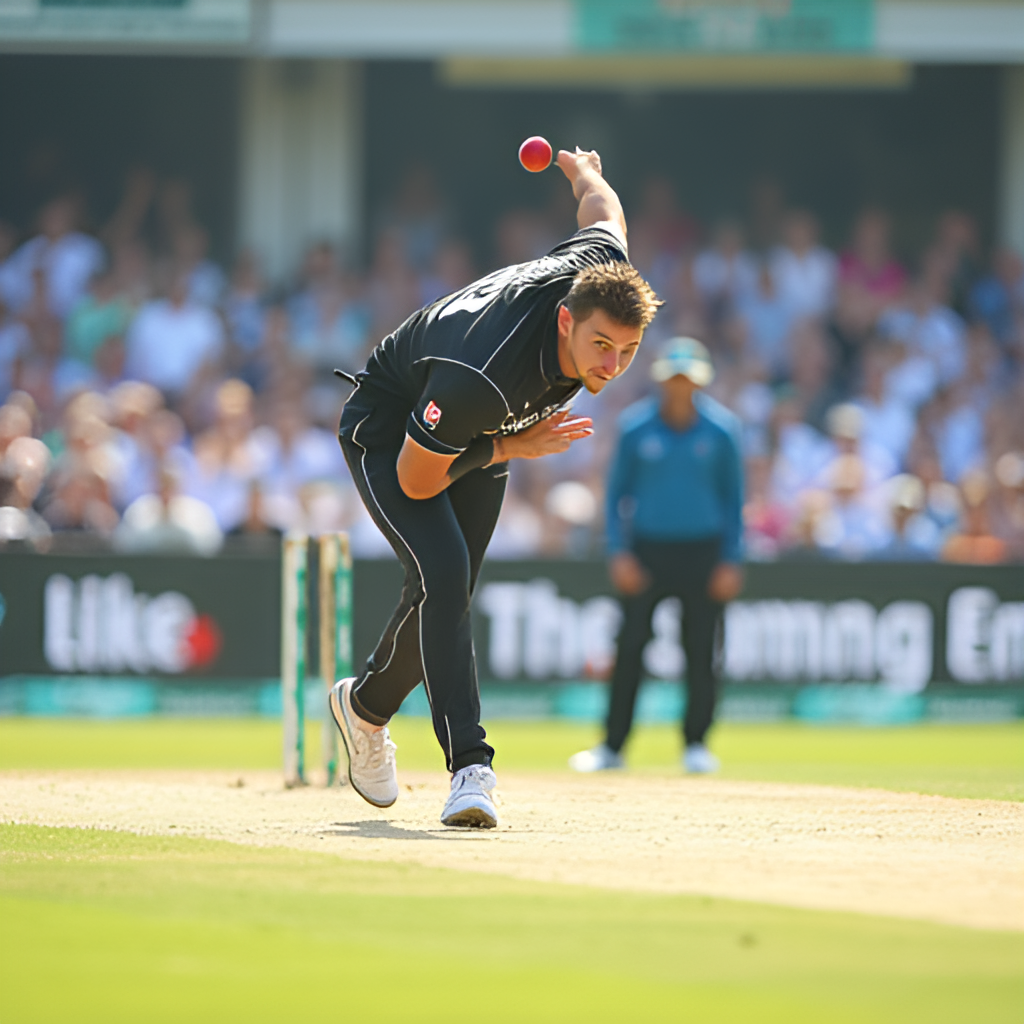
This image is a fictional image generated by GlobalTrendHub.
New Zealand’s Chase: Clinical Efficiency to the Fore
Chasing 121, the Black Caps approached their innings with a calm assurance that truly embodies their “never-say-die” attitude. Despite an early wicket, Devon Conway anchored the chase with an exceptional unbeaten 59 runs off 40 balls, earning him the Player of the Match award. His innings was a blend of calculated risks and precise strokeplay, proving why he’s a vital cog in their batting lineup. Rachin Ravindra provided excellent support with a quickfire 30 off 19 balls, laying the foundation for a comfortable victory. As fans, we often appreciate such clean hitting and sensible batting, making the Black Caps vs Chevrons game summary a delight to re-read. The partnership between Conway and Daryl Mitchell (26 not out off 19 balls) saw them cruise past the target with eight wickets in hand and plenty of overs to spare. This clinical chase further underlined New Zealand’s all-round superiority in this particular match. You can often find full details of these types of matches, including ball-by-ball commentary, on reputable cricket platforms like ESPNcricinfo or Cricbuzz.
| New Zealand Key Batters | Runs (Balls) | Fours | Sixes | Strike Rate |
|---|---|---|---|---|
| Devon Conway | 59* (40) | 4 | 2 | 147.50 |
| Rachin Ravindra | 30 (19) | 4 | 1 | 157.89 |
| Daryl Mitchell | 26* (19) | 1 | 1 | 136.84 |
Decoding the Match Scorecard: Key Statistics and Standouts
Looking at the match scorecard, several key cricket statistics jump out. New Zealand’s bowlers maintained an impressive economy rate throughout Zimbabwe’s innings, rarely conceding easy boundaries. Matt Henry’s bowling figures of 3/26 from 4 overs speak volumes about his impact, disrupting Zimbabwe’s rhythm and taking crucial wickets. On the batting front, Devon Conway’s strike rate of 147.50, especially given his anchoring role, highlights his efficiency. For Zimbabwe, Wessly Madhevere’s innings, despite the team’s struggles, was a testament to his resilience. Analyzing these numbers helps us understand not just the outcome, but the subtle nuances of player performance and how each individual contribution shaped the game. This type of deep dive is what makes cricket analysis so engaging; it’s about seeing beyond just who won and lost.

This image is a fictional image generated by GlobalTrendHub.
Beyond the Scorecard: Strategic Insights and Future Outlook
This particular game, the new zealand national cricket team vs zimbabwe national cricket team match scorecard of which we’ve dissected, offered more than just a result; it provided strategic insights into both teams. New Zealand’s decision to bowl first and their subsequent clinical chase demonstrates a clear strategy focused on maximizing their bowling strengths and relying on their strong batting depth. For Zimbabwe, it’s a learning curve. Despite individual efforts, the inability to forge significant partnerships and accelerate in the middle overs remains a key area for improvement. The T20 Tri-Series is a valuable platform for them to test their mettle against top-tier teams and refine their strategies. As someone observing these team strategies evolve, it’s clear that continuous adaptation and focused training will be crucial for Zimbabwe to bridge the gap with teams like New Zealand. They showed flashes of brilliance, particularly in their fielding, but consistency across all three departments is the ultimate goal.
Conclusion: A Comprehensive Victory and What it Means
In summary, the new zealand national cricket team vs zimbabwe national cricket team match scorecard from the recent T20I Tri-Series fixture paints a clear picture of New Zealand’s comprehensive eight-wicket victory. Their disciplined bowling, spearheaded by Matt Henry, laid the foundation, while Devon Conway’s composed half-century ensured a smooth chase. This match not only cemented New Zealand’s position at the top of the Tri-Series standings but also offered valuable insights into the strengths and areas for development for both squads. For fans, it was a reminder of the Black Caps’ T20 prowess and the Chevrons’ continued journey towards becoming a more consistent force in international cricket. My prediction, based on observing similar series, is that this performance will give New Zealand significant momentum heading into the finals, while Zimbabwe will take valuable lessons from these encounters.